data-rug-linz-eco-monitor
DATA RUG: The Linz Protocol
Materializing environmental forces through data weaving.

STATUS: Work in Progress / Seeking Production
FORMAT: Generative API Installation & Textile Art
TARGET: Ars Electronica 2026
Abstract
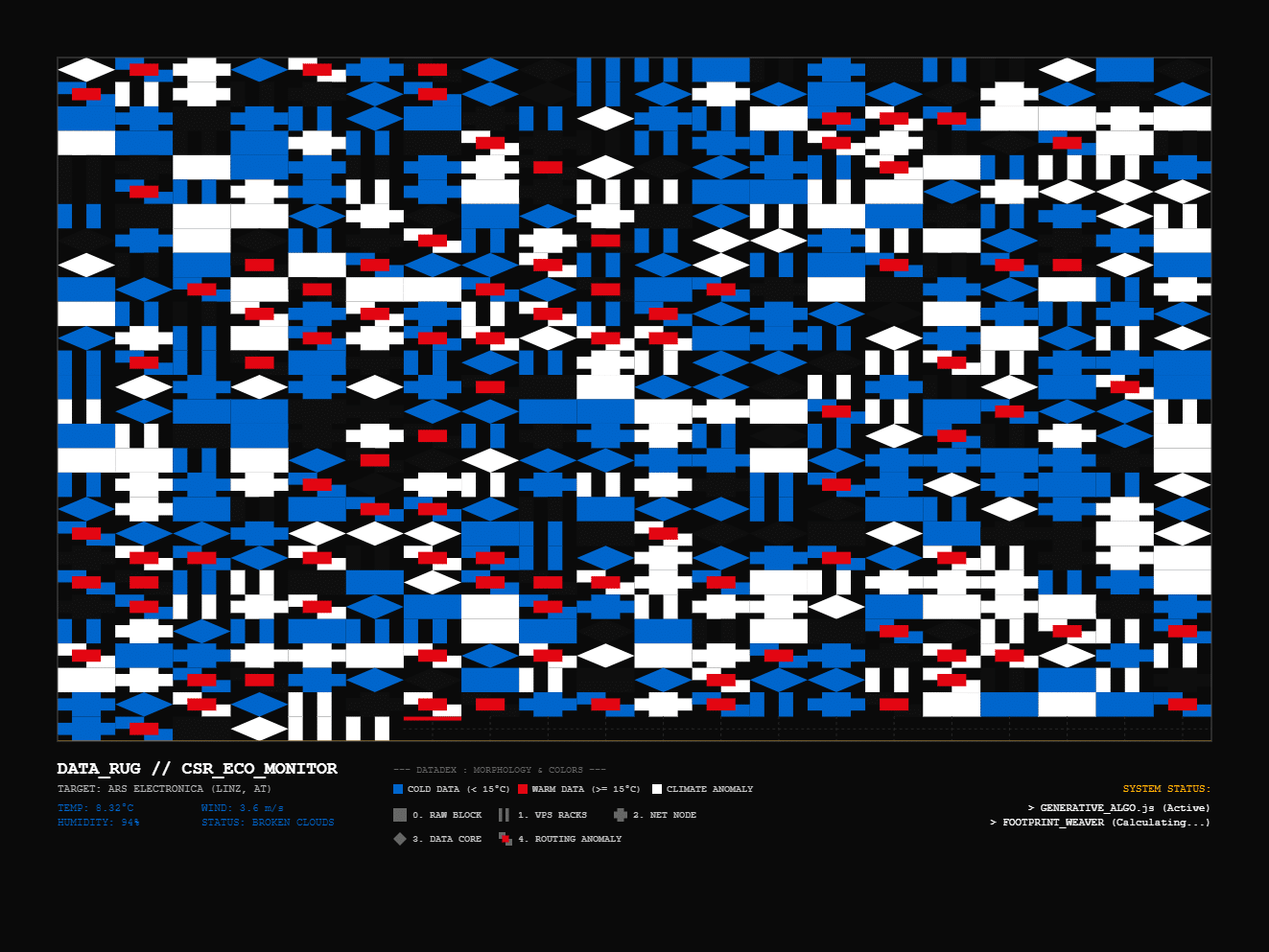
« Data Rug » is a transmedia installation that translates invisible climatic and environmental data into a tangible textile artwork. Using a custom generative algorithm, the project extracts live meteorological conditions to weave them into dynamic geometric cartographies. By bridging the ancestral binary logic of the Jacquard loom with contemporary digital art, the artwork transforms the immateriality of data into a physical and tactile object. At the end of each generative cycle, the matrix is automatically saved: each resulting artwork becomes a unique timestamp of the climate at a specific moment, valorizing the craftsmanship of weavers and ready to be distributed as fine art prints for the public.
Digital Ecology & Cyber-Craftsmanship
In our contemporary daily lives, environmental data reaches us as invisible and ephemeral flows on our screens, disconnecting us from the physical reality of the climate. Data Rug seeks to materialize these invisible forces to awaken our ecological consciousness.
Historically, the Jacquard loom was the first computer, operating on a punch-card system. The Data Rug reconnects this material-bound textile craftsmanship to today’s data. By hybridizing traditional craftsmanship with the aesthetics of information flows, the rug becomes a climatic seismograph. It is not just a simple object; it is an ecological timestamp frozen in thread that the public can touch, walk on, and interact with to grasp the true weight of our environment.
The Generative Protocol
The creation of the Data Rug relies on a live data stream that directly influences its density and morphology:
-
DATA EXTRACTION: For the « Linz Protocol », the algorithm connects to atmospheric and environmental APIs in the city of Linz (Austria). It continuously extracts the invisible forces shaping the urban ecosystem (temperature, humidity, climatic variations).
-
ALGORITHMIC WEAVING: A generative system translates these raw metrics into structural commands revealing environmental impact. Data alters the palette, high saturation increases the density of the algorithmic mesh, and fluctuations induce routing anomalies illustrating the fragility of networks in the face of climate.
-
ARCHIVING, COLLABORATION & PUBLISHING: Upon completing a full generation cycle, the matrix is automatically saved. Each generated rug becomes a unique ecological timestamp (capturing the climate at time T). This approach initiates a direct collaboration and a genuine valorization of artisans and weaving trades, uniting generative technology with ancestral textile know-how. Concurrently, these data « snapshots » can be published as digital and physical fine art prints for the public.
-
MATERIALIZATION: The saved digital blueprints are destined to be transmitted to artisans or industrial looms, transforming each ephemeral snapshot into a unique physical textile piece, debunking the illusion of an immaterial « Cloud ».
Live Simulation: The Linz Monitor
Interact with the live visualizer below. This ecological dashboard monitors the generative algorithm as it extracts live environmental data from Linz and calculates the real-time architecture of the Data Rug.
LINK : https://openprocessing.org/sketch/2877932
CREDITS & PRODUCTION
Lead Artist & Concept: Kamel Ghabte.
Currently seeking production grants and residency opportunities to fund the physical weaving phase (collaboration with industrial Jacquard looms and the publication of fine art prints).