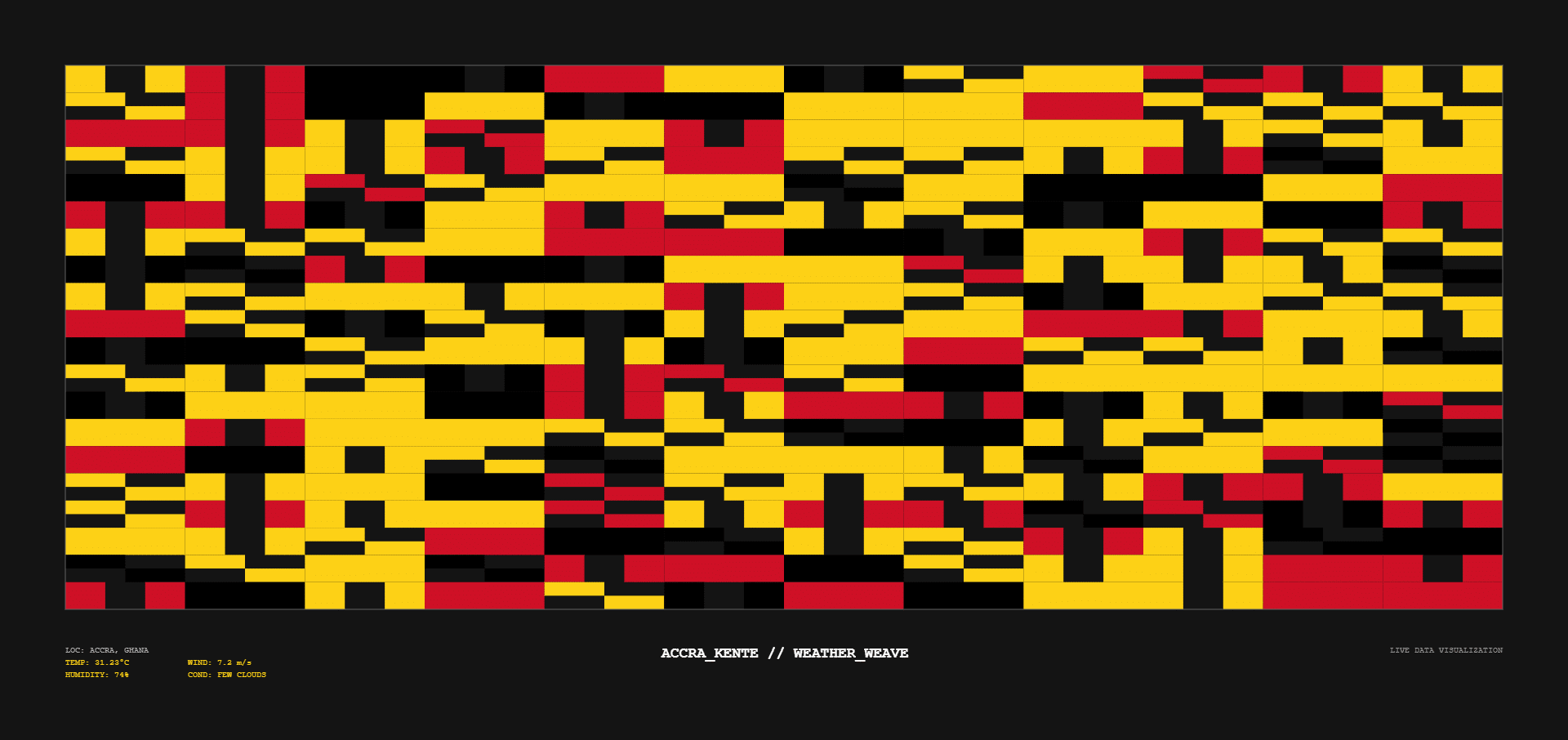
Protocole Data-Rug : Symbiose Algorithmique entre Données Climatiques, Intelligence Artificielle et Artisanat Vernaculaire

ici / L’œuvre numérique perpétuelle
Résumé (Abstract)
Le Protocole Data-Rug propose une nouvelle ontologie de la visualisation de données (Data Art) en couplant des flux environnementaux en temps réel avec les techniques de tissage traditionnel. En exploitant des algorithmes génératifs, ce projet transcrit l’urgence climatique en artefacts physiques et tangibles. Ce document détaille l’architecture technique, l’intégration des enjeux de Responsabilité Sociétale des Entreprises (RSE) et l’impact direct sur les Industries Culturelles et Créatives (ICC) en Afrique.
1. Introduction : De l’Abstraction Climatique à la Matérialité
La crise climatique souffre d’un déficit de représentation : les données météorologiques et environnementales demeurent souvent abstraites pour le grand public. Le Data-Rug Protocol résout ce postulat en créant une interface physique entre la data et l’humain. Il ne s’agit plus de lire un graphique, mais de percevoir l’évolution du climat à travers la trame d’un tapis tissé à la main, où l’Intelligence Artificielle agit comme traductrice entre le capteur environnemental et le métier à tisser.
2. Cadre Conceptuel : Data Art, IA et Enjeux RSE
Ce projet s’inscrit à l’intersection de trois disciplines majeures :
- Data Art et Conscience Écologique : La transformation de métriques (température, hygrométrie, qualité de l’air) en géométries variables offre une lecture sensible et immédiate de l’Anthropocène.
- Éthique Algorithmique : L’IA est ici employée non pas comme un outil d’obsolescence humaine, mais comme un vecteur de préservation. Elle génère une partition que seul le savoir-faire de l’artisan peut interpréter matériellement.
- Impact RSE et Économie Circulaire : En collaborant exclusivement avec des coopératives locales et en utilisant des matériaux biosourcés (laine naturelle, teintures végétales), le protocole garantit une empreinte carbone minimale tout en soutenant l’autonomisation économique des artisans.
3. Architecture Technique et Méthodologie
Le flux de travail (pipeline) repose sur une architecture hybride allant de l’acquisition de données cloud jusqu’à la production physique.
- Acquisition des Données (Input) : Connexion via API aux stations météorologiques locales ou déploiement de capteurs IoT sur le site d’exposition.
- Moteur de Rendu (Processing/p5.js) : Les variables environnementales alimentent un script génératif en temps réel.
- Matérialisation (Output) : Le motif numérique généré est transmis à la coopérative sous forme de « carte de tissage » (mapping nodal).
Modélisation Mathématique : La Matrice NEO-ZELLIGE ARCADE
L’algorithme s’appuie sur une topologie de base fortement ancrée dans le patrimoine architectural. L’évolution du motif « NEO-ZELLIGE ARCADE » se modélise selon la fonction de transformation suivante :
Où :
- M(x,y)(t) représente la valeur du nœud textile aux coordonnées x, y à l’instant t.
- Ek(t) correspond au vecteur de données environnementales (ex: variation de température).
- Z(x,y) est la constante structurelle définissant la géométrie de base de l’arcade zellige.
- α (alpha) est le coefficient de sensibilité algorithmique.
- Δ(P) (delta) introduit une variation stochastique légère pour imiter l’imperfection organique du travail manuel.
Cette formulation garantit que l’architecture complexe de l’arcade évolue organiquement au gré des perturbations climatiques, dilatant ou contractant ses arcs virtuels avant leur fixation dans la laine.
4. Preuve de Concept (Proof of Concept – PoC)
Pour démontrer la viabilité du protocole, un environnement de simulation en temps réel a été développé.
- Lien de la simulation en direct : [Insérer ici votre lien p5.js / hébergement Web]
- Dépôt du code source (Processing) : [Insérer le lien GitHub/GitLab pour Ayoub]
- Documentation des variables : L’interface de simulation permet d’isoler les flux de données entrants et d’observer leur impact direct sur la distorsion de la trame.
5. Déploiement Stratégique (Réseau des Instituts Français)
L’implémentation du protocole propose une approche évolutive et résiliente :
- Installations In Situ : Mise en place d’un métier à tisser couplé à un écran de visualisation en temps réel dans le hall de l’Institut.
- Itinérance Low-Tech : Conception de bornes autonomes permettant de décentraliser la collecte de données et la génération de motifs dans des zones périphériques.
- Valorisation Économique : Les tapis finalisés constituent une collection physique, certifiée par la blockchain pour prouver leur origine temporelle et climatique, créant ainsi une nouvelle source de revenus pour les coopératives impliquées.
Data-Rug Protocol: Algorithmic Symbiosis Between Climate Data, Artificial Intelligence, and Vernacular Craft
(Link): here / the perpetual digital artwork (OpenProcessing)
Abstract
The Data-Rug Protocol proposes a new ontology of data visualization (Data Art) by coupling real-time environmental data streams with traditional weaving techniques. By leveraging generative algorithms, this project translates the climate emergency into physical, tangible artifacts.
This document outlines the technical architecture, the integration of Corporate Social Responsibility (CSR) challenges, and the direct impact on Cultural and Creative Industries (CCIs) in Africa.
1. Introduction: From Climate Abstraction to Materiality
The climate crisis suffers from a representation gap: meteorological and environmental data often remain abstract for the general public. The Data-Rug Protocol addresses this by creating a physical interface between data and humans. It is no longer about reading a chart, but about feeling climate change through the weave of a handwoven rug—where Artificial Intelligence acts as a translator between the environmental sensor and the loom.
2. Conceptual Framework: Data Art, AI, and CSR Stakes
This project sits at the intersection of three major disciplines:
-
Data Art and Ecological Awareness: Transforming metrics (temperature, humidity, air quality) into evolving geometries provides an immediate, sensory reading of the Anthropocene.
-
Algorithmic Ethics: AI is used here not as a tool that replaces human labor, but as a preservation vector. It generates a “score” that only the artisan’s know-how can interpret materially.
-
CSR Impact and Circular Economy: By collaborating exclusively with local cooperatives and using bio-based materials (natural wool, plant-based dyes), the protocol ensures a minimal carbon footprint while supporting artisans’ economic empowerment.
3. Technical Architecture and Methodology
The workflow (pipeline) relies on a hybrid architecture, from cloud data acquisition to physical production.
-
Data Acquisition (Input): API connection to local weather stations, or deployment of IoT sensors on the exhibition site.
-
Rendering Engine (Processing/p5.js): Environmental variables drive a real-time generative script.
-
Materialization (Output): The generated digital pattern is sent to the cooperative as a “weaving map” (nodal mapping).
Mathematical Modeling: The NEO-ZELLIGE ARCADE Matrix
The algorithm is based on a foundational topology deeply rooted in architectural heritage. The evolution of the “NEO-ZELLIGE ARCADE” pattern is modeled through the following transformation function:
[Insert equation here — keep your original formula]
Where:
-
M(x,y)(t) represents the textile node value at coordinates x, y at time t.
-
Eₖ(t) corresponds to the environmental data vector (e.g., temperature variation).
-
Z(x,y) is the structural constant defining the base geometry of the zellige arcade.
-
α (alpha) is the algorithmic sensitivity coefficient.
-
Δ(P) (delta) introduces a slight stochastic variation to mimic the organic imperfection of handcraft.
This formulation ensures that the arcade’s complex architecture evolves organically with climate disturbances—expanding or contracting its virtual arches before being fixed in wool.
4. Proof of Concept (PoC)
To demonstrate the protocol’s viability, a real-time simulation environment was developed.
-
Live simulation link: [Insert your p5.js link / web hosting here]
-
Source code repository (Processing): [Insert GitHub/GitLab link for Ayoub]
-
Variables documentation: The simulation interface makes it possible to isolate incoming data streams and observe their direct impact on weave distortion.
5. Strategic Deployment (Institut Français Network)
The protocol’s implementation offers a scalable and resilient approach:
-
In situ installations: A loom paired with a real-time visualization screen installed in the institute’s lobby.
-
Low-tech touring: Design of autonomous terminals to decentralize data collection and pattern generation in peripheral areas.
-
Economic valorization: Completed rugs form a physical collection, blockchain-certified to prove their temporal and climatic origin—creating a new revenue stream for participating cooperatives.
Ready to deploy the Data-Rug Protocol?
Transform your institute’s lobby with a unique generative artwork, connected in real time to your city’s climate. Let’s discuss technical integration, mediation workshops, and get a tailor-made feasibility study for your spaces.